What makes you meaningfully different at work?
I used to ask my staff that question all the time. Not to be cute. I asked it because most careers stall for the same reason: people confuse competence with distinction.
One day, a senior associate walked into my office, furious that she didn’t get promoted to manager. She was loaded for bear.
She gave me the usual speech—elite schools, straight A’s, scholarships, leadership, great reviews, works hard. The whole resume.
After a few minutes, I yawned.
Not to be cruel. She needed shock paddles. It worked.
Because everything she was telling me was exactly what 95% of the people in an elite firm could say. The “how I’m awesome” speech doesn’t separate you in a room full of high achievers.
Then I said, “You’ve spent the last few minutes telling me how you’re the same as everyone else at the firm. Now tell me how you’re different.”
It landed. Hard. And it carried weight. Because in a client-service business, the people who rise aren’t always the ones with the best technical skills.
They’re the ones who can get other human beings to cooperate, to open up, to trust you when everything is on the line, to move in the direction you know is best for all concerned.
Which brings me to my first public company audit and the fraud discovery that launched my forensics career.
My first fraud discovery didn’t start in the workpapers
I’d been at the firm for about 18 months and had just been promoted to senior audit associate. No authority. No clout. And keep in mind, I hadn’t taken a single auditing class.
And now… I was assigned to audit the largest balance-sheet account at a public company that the market-makers considered a darling on the NASDAQ. Always hitting quarterly and annual EPS targets.
Day one, we set up in the war room, spreading out the binders, calculators, and supplies like ammo and planning the assault: get in, get the audit done before the scheduled earnings release, then roll straight to the next audit with efficiency and purpose.
But as I stared through the floor-to-ceiling windows from our fishbowl—high ceilings, panoramic view, an acre of cubicles. I saw something I’m not sure my colleagues saw.
People.
For the next couple of hours, I played along as if I actually knew how to conduct an audit. I didn’t. Not really. Everyone else had a four-year accounting degree.
Me? I was a former cigarette salesman.
I even had a nickname nobody said to my face: The Experiment. More than a few people thought the office managing partner was crazy to hire a guy like me.
Maybe they were right.
I did my time in the war room with my team that first day. But the next day, I had a different plan.
I walked the floor to meet the company employees who actually ran this place.
Not the executives and managers.
The people who actually touched documents.
The floor walk
My tour started in the lobby.
I learned the receptionist’s name and used it every time I walked by.
That sounds small. It isn’t.
Her desk was command central. She knew everything and everyone.
And when I looked down and saw the 8×10 of a little girl on a podium wearing a medal, I did what any human being should do.
I asked.
She lit up.
A few days later, I started scheduling interviews with the accounting staff.
The first was Ben in accounts payable.
When I stepped into his cubicle, one look told me he didn’t want to meet with me. He didn’t say it. He didn’t have to.
So I didn’t start with accounting questions.
I scanned his space for something real. Something that was meaningful to him outside of the general ledger.
Then I pointed to something on the wall and said, “I’ll bet there’s a story behind that.”
Ben lit up. Vacation story. Then a family photo. I simply asked questions about those things that mattered most to him.
Eight to ten minutes later, I said, “I want to be respectful of your time… so let’s get into my questions, and you can get back to your real job.”
Same Ben. Same workload. Completely different attitude.
Over the next couple of weeks, I did that with everyone I met. Not all responded like Ben, but enough did.
When I met the IT director (who would’ve preferred to lock the server room door and pretend I didn’t exist), I looked around his setup and said, “How do you do it?”
Genuine respect.
He smiled. Because someone finally noticed what he’d built.
Why I did it
We weren’t friends. We were never going to be.
But we had something in common. We were human.
And I needed cooperation—not compliance.
Because while I was building those small relationships, I was also noticing something else.
Something felt off.
The numbers were too clean.
The circularization of receivables revealed no unresolved exceptions. Over 600 letters returned, and not a hitch. No nasty comments, either.
Too clean.
My instincts weren’t shaped by accounting professors. They were shaped by my sales experiences. Observing people. And, yes, watching every episode of Columbo (1970s TV series).
Then I noticed behavior that didn’t match the “everything is great” story: the CEO, who was supposedly on vacation, showed up, got aggressive with the CFO… and slammed the door when he noticed me watching.
So I carefully probed. Through the CFO’s secretary. And I kept doing what I’d been doing: leaving breadcrumbs that communicated: “I’m decent. I’m fair. I’m here for the truth.”
Because I believed this then and now:
If something is going wrong inside an organization, there is at least One Honest Soul (title of book two in my thriller series) who knows about it and is just looking for someone they can trust, someone with the power to do the right thing.
And then came my break
Late night. Everyone else had gone home. I was trying to wrap up my audit testing.
Earlier that day, I was having a conversation with the accounts receivable clerk and noticed a file lying on her desk… a thick file labeled “Complaints.”
Complaints?
First I’d ever seen it. Later that evening, I began to investigate that file. Inside was letter after letter from leaseholders complaining about the company’s equipment, service, billings, and more. I was stunned. Customer complaints did not fit the narrative I’d been hearing.
After two hours, I was convinced I’d been looking in all the wrong places. Time to take a diversion from the approved audit program.
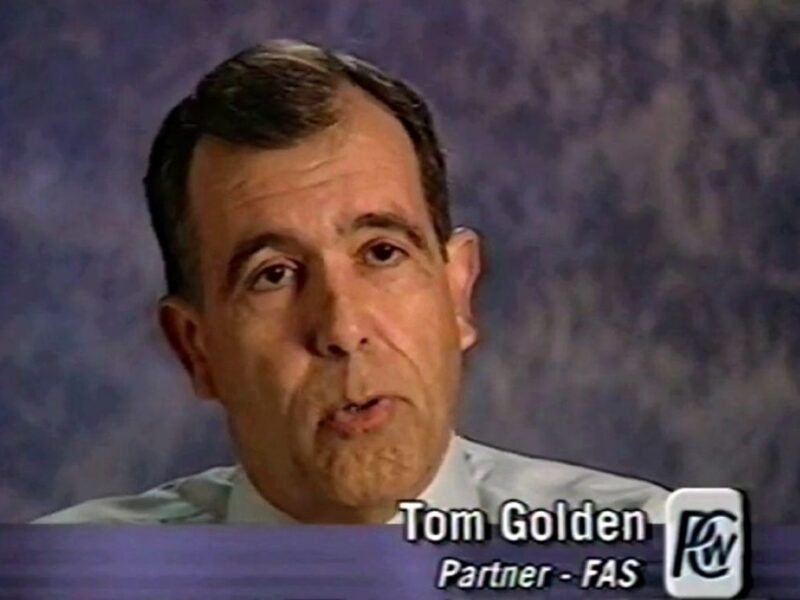
That began what court documents and FBI Form 302s later referred to as “Tom Golden’s clandestine investigation.”
One thing led to another. More questions. More digging.
And eventually, with help from the IT director, I confirmed the company had been running a massive leasing scam which had begun prior to the IPO an each following year. All with my firm’s clean audit opinions attached.
The magnitude of the fraud was staggering—about 25% of net income for the current year alone.
At 2:00 a.m., five days before earnings release, and still at the company, I called the engagement partner and told him, “You need to get in here. Now!”
He wasn’t smiling when he arrived. He grabbed my evidence binder and secluded himself.
I assumed I was about to get fired for operating way outside the lines.
Instead, he walked out about an hour later, looked at me, and said: “We’ve got a big problem. I need to assemble the board.”
It all went downhill fast.
So what happened here?
I didn’t discover that fraud because I was the most technically skilled auditor on my team.
I found it because people trusted me enough to let the truth leak into my line of sight.
I could only guess why that Complaint file happened to appear.
Today, we’d call them a whistleblower. Back then, I’d never heard the term. (See my previous post on Whistleblower Hotlines)
This is the part most “high performers” don’t want to hear
In Part 1 of Beyond the Numbers, I talked about real listening. The kind where you ask one more question, and you don’t rush to prove you’re smart.
That’s not a personality thing.
That’s professional leverage.
Because fraud detection isn’t just an accounting problem.
It’s a human problem.
Fraud thrives inside trust, access, and silence. Right under the noses of smart people who assume they have all the answers when they don’t even know the right questions to ask.
And that’s why I’ve said it before (and I’ll keep saying it):
Documents tell only part of the story. People tell the rest.
Five people-skill moves you can use immediately
- Lead with curiosity, not credentials. Your technical skills start the conversation. Your people skills decide whether anyone helps you finish it.
- Everyone has a name. Remember it. Use it. It’s a small thing that signals respect fast.
- Start human, then go technical. Find the story behind that moment (photo, trophy, souvenir). That time spent earns you the right to go deeper—if it’s sincere. Relationships are forged.
- Ask one more question than everyone else. Most people stop too early because they’re in a hurry or they’re afraid of appearing dumb.
- Be the kind of person someone wants to be around… or help. Not by schmoozing. By being fair. Calm. Consistent. Demonstrating a sincere interest in other people. And committed to doing the right thing.
One last thought
If you want to stand out, stop trying to be “impressive.”
Be different, but in a way that is purposeful and effective.
Because in the moments that matter—the interview, the board presentation, testifying as an expert witness, the tense audit room. Being smart is just table stakes. The firm is full of smart people.
But doing the things that attract people to move with you?
That’s the edge you should be seeking.
So I’ll ask you again:
“How are you different from your peers? What’s your edge?”
—Tom Golden
To hear more about these “soft skills” and how to conduct investigations when it’s all on the line, subscribe to my blog where every Friday afternoon I’ll have a new post.
Frequently Asked Questions
What is the difference between competence and distinction in a professional career?
Competence is doing your job well. Distinction is doing it in a way that makes you irreplaceable. Tom Golden, CFE, observed throughout his career at PwC that most careers stall because professionals confuse the two. In an elite firm full of high achievers with strong credentials, technical competence is the baseline – not the differentiator. What sets people apart is their ability to get other human beings to cooperate, open up, and trust them when everything is on the line. Distinction comes from the human skills that sit beyond the technical ones.
How do you stand out professionally in a competitive field?
To stand out professionally in a competitive field, you need to be able to answer one question clearly: how are you different, not just how are you good? Tom Golden’s advice to his staff at PwC was that describing your education, grades, and work ethic describes how you are the same as most people in an elite firm. What matters is what you bring that others do not – typically the ability to build trust, lead people through difficult situations, communicate clearly under pressure, and earn cooperation when it is not guaranteed. In client-service businesses especially, the people who advance are those who can move human beings in the right direction.
How did people skills help Tom Golden discover fraud on his first audit?
Tom Golden discovered fraud on his very first public company audit not by following standard procedures but by paying attention to people. While other auditors focused on workpapers and binders, Golden looked through the floor-to-ceiling windows at the open office and noticed the employees – their behavior, their demeanor, the way they interacted. His background in sales had trained him to read rooms and notice what others miss. That instinct led him to ask different questions and pursue different threads than a by-the-book auditor would have, ultimately uncovering a fraud that previous auditors had missed entirely.
Why do careers stall even when professionals are technically strong?
Careers stall when professionals mistake competence for distinction. Tom Golden saw this repeatedly at PwC – talented people with strong credentials who plateaued because they could not make the transition from doing the technical work to leading people through it. In a room full of high achievers, everyone is technically strong. The people who advance are those who can earn trust, communicate with impact, manage difficult relationships, and inspire cooperation from clients, witnesses, and colleagues. Technical skill gets you in the door. Human skill determines how far you go.
What role does listening play in forensic accounting and fraud investigation?
Listening is one of the most important and most underused skills in forensic accounting and fraud investigation. Tom Golden emphasizes that the critical information in most investigations comes not from documents but from people – witnesses who are nervous, conflicted, or uncertain whether to speak up. An investigator who listens actively, without interrupting or rushing to the next question, signals respect and safety to the person across the table. That creates the conditions for candor. In Golden’s experience, the investigators who listen best are the ones who learn the most.