

The Truth About Success No One Talks About I didn’t build this blog to impress anyone.I built it because the road I walked wasn’t easy—and most people never hear the truth about what it really takes to succeed—in investigations, in business, or in life. If you’re looking for corporate platitudes or recycled LinkedIn advice, you won’t find it here.I don’t write about “best practices.”I write about the choices that make or break your reputation when no one’s watching. Along the way, I came to understand something most people never say out loud. Success doesn’t happen because you went to the …

Beyond the Numbers (Part 2): What Made Me Different
What makes you meaningfully different at work? I used to ask my staff that question all the time. Not to be cute. I asked it because most careers stall for the same reason: people confuse competence with distinction. One day, a senior associate walked into my office, furious that she didn’t get promoted to manager. She was loaded for bear. She gave me the usual speech—elite schools, straight A’s, scholarships, leadership, great reviews, works hard. The whole resume. After a few minutes, I yawned. Not to be cruel. She needed shock paddles. It worked. Because everything she was telling me …
Beyond the Numbers (Part 2): What Made Me DifferentRead More

Beyond The Numbers (Part 1): You’ll Find People
Maybe you’ve heard the term “soft skills” and know, or at least have a general idea, what it means. Or maybe you have no clue. No matter. Here’s the nut of it: Soft skills are the human skills that make your technical skills useful. How you communicate, earn trust, read a room, and move work (and people) from confusion to clarity. And in a world where AI will be encroaching on most of the tasks previously performed by new hires, mastering these skills, especially the art of conversation, will set you apart. In other words, these are the skills that …

Trust But Verify: The Only Way Trust Survives
Before Behavior Can Change—Belief Must Change Most people think fraud comes from the outside. A hacker. A thief. A stranger. That’s comforting, but it’s also usually wrong—at least when it comes to accounting fraud, corruption, and the quiet kinds of theft that happen in plain sight. Because the real threat usually isn’t “out there.” It’s inside your org chart. Inside your approvals. Inside your assumptions. And most of the time, it’s not your system… It’s the person sitting at the keyboard. In my work, the people most likely to defraud you are rarely strangers. They’re the people you already know. …

Whistleblower Hotlines: The Most Effective Way to Detect Financial Fraud
Why Perception Matters Most in Preventing Fraud Most corporate criminals don’t operate in the shadows, obsessively covering their tracks. As part of management or as a trusted, longtime employee, they operate with impunity because they know they won’t get discovered. And in too many situations, they’re right. That’s the uncomfortable truth. If you want to prevent financial crime, or at least discover it early, a whistleblower hotline isn’t optional. When designed properly, it is one of the most effective tools an organization can deploy—both as a deterrent and as an early-warning system. This post is not about theory or stats. It’s testimony …
Whistleblower Hotlines: The Most Effective Way to Detect Financial FraudRead More
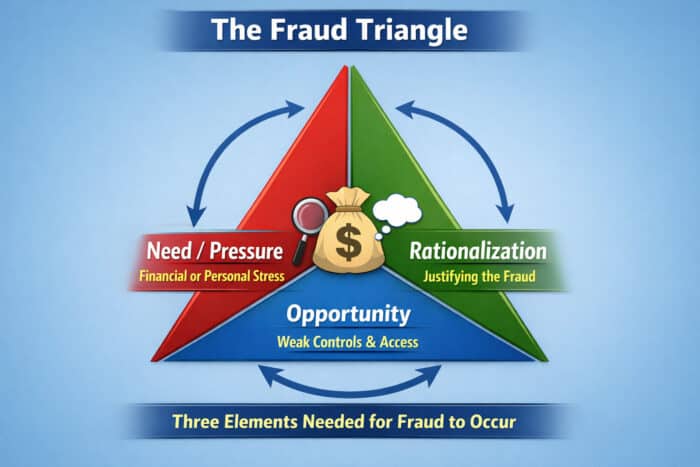
Fraud Triangle: How Good People Cross the Line
Trust people until they give you a reason not to. It sounds generous. Civilized. Even moral. Unfortunately, when it comes to fraud—and to many of the worst betrayals in life—that advice fails at the exact moment it matters most. In my career investigating financial crimes, I learned a hard truth early on: the people most likely to defraud you are rarely strangers. They are the people you already know. The people you rely on. The people you trust. And by the time they “give you a reason not to,” the damage is already done. Why Accounting Fraud Rarely Comes From …

How Ordinary People Rationalize Extraordinary Crimes
Most of us grew up being told the same things by our parents—especially our mothers: Don’t lie. Don’t cheat. Don’t steal. At least, that was true in my generation. So when people hear about white‑collar crime, they often assume the perpetrators must be fundamentally different from the rest of us. Greedy. Sociopathic. Wired wrong. That assumption is comforting—and dangerously wrong. After decades of investigating financial crimes, I can tell you this: most white‑collar criminals do not see themselves as criminals at all. They believe, in their heart of hearts, that they are good people who were placed in impossible situations. …
How Ordinary People Rationalize Extraordinary CrimesRead More

A Forensic Accounting Investigations Starts Before Interviews
It’s Not Just About Following the Money When people hear the term forensic accounting investigation, they often picture spreadsheets, bank records, and late nights following money trails. That part matters—but it’s not where an investigation truly begins… rather, where it should begin. Long before the first document request or interview, an investigator is already at work. The outcome of the case is often shaped before a single question is asked. I’ve spent decades investigating financial crimes—corporate fraud, public corruption, financial statement manipulation—and I can tell you this with confidence: the technical work only succeeds when the human groundwork has already …
A Forensic Accounting Investigations Starts Before InterviewsRead More